
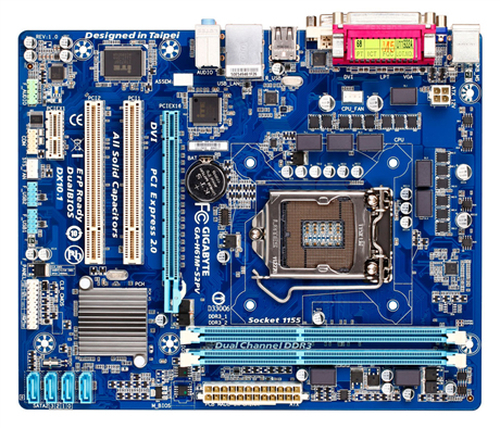
GIGABYTE GA-H61M-S1 motherboard Intel H61 LGA 1155 (Socket H2) micro ATX
- Socket: LGA 1155 (Socket H2)
- Chipset: Intel H61
- Form factor: micro ATX
- Memory: 2 × DDR3-SDRAM, up to 16 GB
- Network: Gigabit Ethernet
Where to buy
We're not tracking prices for this product yet. Check current prices directly at:
We may earn a commission when you buy through links on this page — at no extra cost to you. Learn more
About this product
Humidity Protection
Humidity can play havoc on a motherboard's circuitry.GIGABYTE's new Glass Fabric PCB design helps protect against electrical shorts due to humidity by reducing the gaps in spacing between PCB filaments.
Electrostatic Protection
GIGABYTE motherboards feature High Resistance ICs which help protect the motherboard against electrostatic discharge.
Power Failure Protection
GIGABYTE also uses Anti-Surge ICs to protect the motherboard against power surges.
Support Intel 22nm processors
GIGABYTE motherboards support Intel 22nm processors.
Designed for PCI Express Gen.3 Support
The GIGABYTE motherboard is fully configured to provide gamers with the latest Gen.3 PCI Express technology, delivering maximum data bandwidth for forthcoming discrete graphics cards.
Intel HD Graphics Core 2000/3000 Enhanced Visual Features
Intel Quick Sync Video
Intel Quick Sync Video provides breakthrough media processing for incredibly fast editing and sharing.
Intel InTru 3D
2nd Generation Intel Core Processors offer an outstanding Blu-Ray Stereo 3D experience in full high definition resolution (1080p) with HDMI 1.4.
Intel Advanced Vector Extensions (AVX)
Increases the performance of Accelerated Floating Point and Vector Computing Intensive Applications with minimal power gains.
On/Off Charge Technology
GIGABYTE On/Off Charge technology allows you to charge your iPhone, iPad and iPod Touch regardless of whether your PC is on, in standby mode or even off. A derivative of GIGABYTE's highly acclaimed 3x USB Power feature, On/Off Charge enables devices to draw more current from GIGABYTE motherboard USB ports than standard USB ports allow, so that charging from your PC can be as fast as with a charger
ErP Lot 6 support
The ErP (also known as Energy-Related Products Directive) is part of the European Union's environmental regulations policy. It is based on concern for the environmental as the proliferation of electronic devices continues, and how to improve energy efficiency for a better and greener life. GIGABYTE supports ErP and produces motherboards that help you effectively improve system efficiency.
Specifications
Key specifications
- Processor socketMechanical component(s) that provides mechanical and electrical connections between a microprocessor and a printed circuit board (PCB). This allows the processor to be replaced without soldering.
- LGA 1155 (Socket H2)
- Motherboard chipsetThe chipset connects the microprocessor to the rest of the motherboard.
- Intel H61
- Motherboard chipset familyThe category of motherboard chipset e.g. Intel, AMD.
- Intel
- Motherboard form factorDesign of the motherboard (ATX, BTX etc).
- micro ATX
- Number of memory slotsThe total number of available sockets for installing memory modules.
- 2
- Supported memory typesTypes of memory which can be used with the product.
- DDR3-SDRAM
- Maximum internal memoryThe maximum amount of memory inside a product, usually measured in bytes e.g megabytes (MB) or gigabytes (GB).
- 16 GB
- Ethernet interface typeThe maximum data transfer rate supported by the network port, expressed in gigabits per second (e.g., 10 Gigabit Ethernet).
- Gigabit Ethernet
Show all 44 specificationsShow key specifications only
Features
- Motherboard form factorDesign of the motherboard (ATX, BTX etc).
- micro ATX
- Motherboard chipset familyThe category of motherboard chipset e.g. Intel, AMD.
- Intel
- Memory voltageThe voltage (V) of the memory in the device.
- 1.5 V
Memory
- Supported memory typesTypes of memory which can be used with the product.
- DDR3-SDRAM
- Number of memory slotsThe total number of available sockets for installing memory modules.
- 2
- Memory slots typeA memory slot, also known as a memory socket or RAM slot, is what allows computer memory (RAM) to be inserted into the computer. Depending on the motherboard, there will usually be 2 to 4 memory slots (sometimes more on high-end motherboards). The most common types of RAM are SDRAM and DDR for desktop computers and SODIMM for laptop computers, each having various types and speeds.
- DIMM
- Memory channelsThe number of communication paths between the memory controller and the RAM, which affects data transfer bandwidth (e.g., Dual-channel).
- Dual-channel
- ECC сompatibilitySpecifies whether the product supports Error Correction Code (ECC) memory, which detects and fixes data corruption (e.g., ECC, non-ECC).
- Non-ECC
- Supported memory clock speedsMemory clock speed is the time it takes for a computer to complete basic operations. It refers to the computer's processing speed and is measured in hertz. It is however not such a reliable measure of a computer's speed as it doesn't take into account other factors like RAM and cache size.
- 800,1066,1333,2200 MHz
- Maximum internal memoryThe maximum amount of memory inside a product, usually measured in bytes e.g megabytes (MB) or gigabytes (GB).
- 16 GB
- Supported memory module capacitiesThe maximum amount of RAM that can be installed per memory slot, such as 128GB or 192GB.
- 2GB, 4GB, 8GB
Processor
- Processor manufacturerThe manufacturer that produced the processor.
- Intel
- Processor socketMechanical component(s) that provides mechanical and electrical connections between a microprocessor and a printed circuit board (PCB). This allows the processor to be replaced without soldering.
- LGA 1155 (Socket H2)
- Compatible processor seriesA processor which is compatible with this device, belongs to a 'series' which is part of 'family' e.g Celeron D, Celeron G, Celeron M, or, in some cases, is the same as 'family'.
- Intel Celeron, Intel Pentium
- PCI Express slots versionSpecifies the generation of the PCI Express standard supported by the expansion slots, which determines the available data transfer bandwidth (e.g., 4.0).
- 3.0
- Parallel processing technology supportParallel processing technology is the simultaneous use of more than one CPU or processor core to execute a program or multiple computational threads. Ideally, parallel processing makes programs run faster because there are more engines (CPUs or Cores) running it. In practice, it is often difficult to divide a program in such a way that separate CPUs or cores can execute different portions without…
- Not supported
- Maximum number of SMP processorsThe highest number of symmetric multiprocessing (SMP) processors that the system can support.
- 1
Weight & dimensions
- WidthThe measurement or extent of something from side to side.
- 226 mm
- DepthThe distance from the front to the back of something.
- 174 mm
BIOS
- BIOS typeThe BIOS (Basic Input/Output System) initializes and tests system hardware components, and loads a bootloader or an operating system from a mass memory device. The BIOS additionally provides abstraction layer for the hardware, i.e. a consistent way for application programs and operating systems to interact with the keyboard, display, and other input/output devices. There are several types of BIOS…
- EFI AMI
- ACPI versionThe version of the Advanced Configuration and Power Interface standard supported by the device to manage power consumption and hardware configuration (e.g., 2.0).
- 2.0a
- Clear CMOS jumperIndicates whether the product features a physical jumper to reset the CMOS settings to their factory defaults.
- Yes
Expansion slots
- PCI Express x1 slotsThe number of available expansion slots that support a single lane of PCI Express connectivity for adding peripheral cards.
- 2
- PCI Express x16 slotsThe total number of available PCI Express x16 expansion slots for installing high-bandwidth components.
- 1
Performance
- Motherboard chipsetThe chipset connects the microprocessor to the rest of the motherboard.
- Intel H61
- Audio output channelsAn audio output channel is an electric circuit which acts as a path for a signal produced by a device. A device may have several audio output channels.
- 7.1 channels
- Ethernet interface typeThe maximum data transfer rate supported by the network port, expressed in gigabits per second (e.g., 10 Gigabit Ethernet).
- Gigabit Ethernet
Power
- Power source typeWhat the power source is.
- ATX
Other features
- Compatible operating systemsList of desktop operating systems tested as compatible with this product.
- Microsoft Windows 7/Vista/XP
Network
- LAN controllerThe specific hardware chip or chipset that manages the network interface and handles data transmission (e.g. Intel I219-V).
- Realtek RTL8111F
- Networking featuresSpecifies the available connectivity options and network protocols supported by the device.
- Gigabit Ethernet
Ports & interfaces
- USB 2.0 ports quantityNumber of USB 2.0 ports (connecting interfaces) in the device. USB 2.0 was released in April 2000 (now called "Hi-Speed"), adding higher maximum signaling rate of 480 Mbit/s (effective throughput up to 35 MB/s or 280 Mbit/s), USB 2.0 ports are usually black.
- 4
- Ethernet LAN (RJ-45) portsNumber of Ethernet LAN (RJ-45) ports (connecting interfaces) in the device. Ethernet LAN (RJ-45) ports allow a computer to connect to the ethernet.
- 1
- PS/2 ports quantityThe number of PS/2 connectors for keyboards and mice. Its name comes from the IBM Personal System/2.
- 2
- VGA (D-Sub) ports quantityNumber of VGA (D-Sub) ports (connecting interfaces) in the device. The VGA (D-Sub) connector is a 15 pin connector between a computer and a monitor. It was first introduced in 1987 by IBM.
- 1
- Headphone outputsNumber of sockets /ports where headphones are connected.
- 1
- Microphone inThe socket where a microphone is connected to the device.
- Yes
Internal I/O
- USB 2.0 connectorsThe end of a cable with a USB 2.0 connector. USB 2.0 was released in April 2000 (now called "Hi-Speed"), adding higher maximum signaling rate of 480 Mbit/s (effective throughput up to 35 MB/s or 280 Mbit/s), in addition to the "USB 1.x Full Speed" signaling rate of 12 Mbit/s. USB 2.0 connectors are usually colored black.
- 2
- Number of SATA II connectorsSerial ATA (Advanced Technology Attachment) (SATA) is a computer bus interface that connects host bus adapters to mass storage devices such as hard disk drives and optical drives. SATA II (revision 2.x) interface, formally known as SATA 3Gb/s, is a second generation SATA interface running at 3.0 Gb/s. The bandwidth throughput, which is supported by the interface, is up to 300MB/s.
- 4
- Front panel audio connectorIndicates whether the product has a dedicated header to connect audio jacks located on the front panel of a chassis.
- Yes
- ATX Power connector (24-pin)Indicates whether the product features a 24-pin ATX power connector for main power supply connectivity.
- Yes
- CPU fan connectorIndicates whether the product has a dedicated header for connecting a CPU cooling fan.
- Yes
Graphics
- On-board graphics cardGraphics hardware which is built into the motherboard or CPU, as opposed to a separate graphics adapter (video card). On-board graphics uses CPU and RAM for graphics processing.
- No
Storage
- Supported storage drive interfacesThe physical and logical connection standards supported for connecting storage drives to the system (e.g., M.2 or SATA).
- SATA II
Database Right data-sheet 2026 Icecat. All rights reserved. Provided “as is”, without warranty — check details with the store before buying.
Price history (90 days, best daily price)
Price history is still being collected for this product — check back soon.
Alternative models

GIGABYTE GA-H61MA-D3V motherboard
Intel H61 LGA 1155 (Socket H2) micro ATX

GIGABYTE GA-780T-D3L motherboard
AMD 760G Socket AM3+ ATX

GIGABYTE GA-H61MA-D2V motherboard
Intel H61 LGA 1155 (Socket H2) micro ATX
GIGABYTE GA-H61M-S2PV motherboard
Intel H61 LGA 1155 (Socket H2) micro ATX

GIGABYTE GA-P61A-D3 motherboard
Intel H61 LGA 1155 (Socket H2) ATX
