
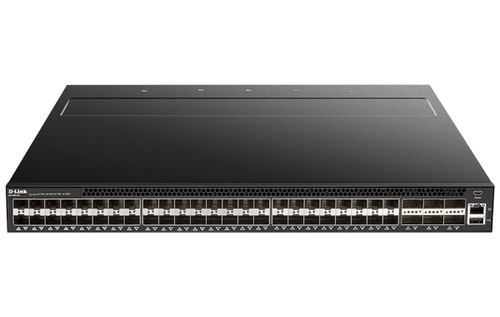
D-Link DXS-5000-54S/SI network switch Managed L3+ 10G Ethernet (100/1000/10000) 1U
- Rack mounting
- MAC address table: 288000 entries
- Basic switching RJ-45 Ethernet ports quantity: 48
- Basic switching RJ-45 Ethernet ports type: 10G Ethernet (100/1000/10000)
- Switch type: Managed
- Compliance certificates: CE
Where to buy
We're not tracking prices for this product yet. Check current prices directly at:
We may earn a commission when you buy through links on this page — at no extra cost to you. Learn more
About this product
The D-Link DXS-5000-54S/SI 54-Port 10G/40G Enterprise Aggregation Switch features high port density, routing, and ultra-low latency, designed to be deployed as aggregation switches for enterprise as well as Top-of-Rack (ToR) or leaf-spine switches in data center applications.
The DXS-5000-54S/SI switch offers a combination of high-capacity SFP+ and QSFP+ ports to accommodate the scale and requirements of enterprises and data centers. It deliver high performance, flexibility, fault tolerance, and advanced software features for maximum return on investment. With ONIE support, the DXS-5000-54S/SI provides the option for managing and expanding enterprise and data center infrastructures in a Software-defined Networking (SDN) environment.
High Availability and Reliability
The DXS-5000-54S/SI features a modular fan and power supply design for a high availability architecture. The hot-swappable design means that fans and power supplies can be replaced without affecting switch operation. Load sharing enables both power supplies to evenly distribute load to increase reliability and lifetime. Meanwhile, 1+1 redundancy minimises downtime in case of a single power supply failure.
Comprehensive Layer 2/3 Functionality
The DXS-5000-54S/SI features an extensive L2 and L3 feature set to meet the demands of enterprise applications. Layer 2 features include L2 switching, L2 multicast, advanced Quality of Service (QoS), and robust security features. Meanwhile, the DXS-5000-54S/SI offers advanced L3 routing for enterprise integration, including OSPF, BGP, Graceful Restart, Bidirectional
Forwarding Detection (BFD), and L3 multicast.
Documents
- BrochureProduct Brochure ↗
Specifications
Key specifications
- Rack mountingThe type of mounting that can position devices in a shelving system (rack).
- Yes
- MAC address tableThe MAC address is the 'Media Access Control Address'. It is a unique address given to a network interface controller (NIC) in a device. A MAC address table shows the addresses in a table format.
- 288000 entries
- Basic switching RJ-45 Ethernet ports quantityThe number of basic switching RJ-45 Ethernet ports (sockets).
- 48
- Basic switching RJ-45 Ethernet ports typeThe type/category of basic switching RJ-45 Ethernet ports (sockets).
- 10G Ethernet (100/1000/10000)
- Switch typeWhat switch device has, managed or unmanaged.
- Managed
- Compliance certificatesIndicates which regulatory, safety, and environmental standards the product complies with, as verified by recognized authorities or certification bodies.
- CE
- CertificationSpecifies the official standards, safety approvals, or regulatory certifications the product has received.
- cULus CCC BSMI CB CE
- Sustainability complianceIndicates whether the product complies with established environmental and sustainability standards.
- Yes
- Operating temperature (T-T)The minimum and maximum temperatures at which the product can be safely operated.
- 0 - 45 °C
- Storage temperature (T-T)The minimum and maximum temperatures at which the product can be safely stored.
- -40 - 70 °C
Show all 71 specificationsShow key specifications only
Power over Ethernet (PoE)
- Power over Ethernet (PoE)The device supports Power over Ethernet (PoE), which is one of several standardized or ad-hoc systems which pass electrical power along with data on Ethernet cabling. This allows a single cable to provide both data connection and electrical power to devices such as wireless access points or IP cameras.
- No
Design
- Rack mountingThe type of mounting that can position devices in a shelving system (rack).
- Yes
- StackableDevices can be placed on top of each other.
- No
- Form factorThe shape or design of the product.
- 1U
- LED indicatorsThe specific status lights available on the unit to provide visual feedback on its current state or connectivity (e.g., AC input, ACT, or Access).
- Yes
- Redundant fans supportIndicates whether the system supports the installation of additional fans to ensure continued cooling in the event of a single fan failure.
- Yes
- Number of fansThe quantity of fans (apparatus with rotating blades that creates a current of air for cooling or ventilation).
- 4 fan(s)
Data transmission
- MAC address tableThe MAC address is the 'Media Access Control Address'. It is a unique address given to a network interface controller (NIC) in a device. A MAC address table shows the addresses in a table format.
- 288000 entries
- Switching capacityThe data transfer capacity of the switch per second.
- 1440 Gbit/s
- Forwarding rateThe number of packets the device can process and send per second, measured in millions of packets per second (e.g., 148.8 Mpps).
- 1071 Mpps
- Static routeIndicates whether the device allows the manual configuration of fixed paths for network traffic to specific destinations.
- Yes
- Number of IP interfacesThe total number of logical or physical network interfaces that can be assigned an IP address on the device.
- 128
- Jumbo framesIndicates the support for Ethernet frames larger than the standard 1500 bytes to increase data transfer efficiency (e.g. 9000 bytes).
- 9000
Ports & interfaces
- Basic switching RJ-45 Ethernet ports quantityThe number of basic switching RJ-45 Ethernet ports (sockets).
- 48
- Basic switching RJ-45 Ethernet ports typeThe type/category of basic switching RJ-45 Ethernet ports (sockets).
- 10G Ethernet (100/1000/10000)
- Installed QSFP+ modules quantityThe total number of Quad Small Form-factor Pluggable Plus transceivers pre-installed in the device.
- 6
- Console portThe type of physical connector used for the management or console interface of the device (e.g. RJ-45 or USB).
- Micro-USB
- USB 2.0 ports quantityNumber of USB 2.0 ports (connecting interfaces) in the device. USB 2.0 was released in April 2000 (now called "Hi-Speed"), adding higher maximum signaling rate of 480 Mbit/s (effective throughput up to 35 MB/s or 280 Mbit/s), USB 2.0 ports are usually black.
- 1
Management features
- Switch typeWhat switch device has, managed or unmanaged.
- Managed
- Switch layerA network switch is a computer networking device that links networking segments. A switch has different layers, such as layer 2 (a network bridge, operating at the data link layer, interconnecting a small number of devices) and layer 4 (can act as a firewall, amongst other things).
- L3+
- Quality of Service (QoS) supportIndicates whether the device supports Quality of Service (QoS) to prioritize specific network traffic to ensure performance for critical applications.
- Yes
- Traffic classificationIndicates whether the device can identify and categorize network data packets based on predefined criteria to prioritize specific types of traffic.
- Yes
- Traffic shapingIndicates whether the device can control the flow of network traffic to optimize performance and ensure guaranteed bandwidth for specific applications.
- Yes
- Configuring Location Settings (CLI)Indicates whether location settings can be configured via the command line interface (CLI).
- Yes
- System event logIndicates whether the device maintains a record of internal system events and status changes for diagnostic purposes.
- Yes
Certificates
- Compliance certificatesIndicates which regulatory, safety, and environmental standards the product complies with, as verified by recognized authorities or certification bodies.
- CE
- CertificationSpecifies the official standards, safety approvals, or regulatory certifications the product has received.
- cULus CCC BSMI CB CE
Sustainability
- Sustainability complianceIndicates whether the product complies with established environmental and sustainability standards.
- Yes
Weight & dimensions
- WidthThe measurement or extent of something from side to side.
- 440 mm
- DepthThe distance from the front to the back of something.
- 406 mm
- HeightThe measurement of the product from head to foot or from base to top.
- 44 mm
- WeightWeight of the product without packaging (net weight). If possible, the net weight is given including standard accessories and supplies. Please note that sometimes the manufacturer leaves out the weight of accessories and/or supplies.
- 9 kg
Operational conditions
- Operating temperature (T-T)The minimum and maximum temperatures at which the product can be safely operated.
- 0 - 45 °C
- Storage temperature (T-T)The minimum and maximum temperatures at which the product can be safely stored.
- -40 - 70 °C
- Operating relative humidity (H-H)The range of relative humidity, expressed as a percentage, within which the device can function correctly without damage or performance loss.
- 5 - 95%
- Storage relative humidity (H-H)The permissible range of relative humidity, expressed as a percentage, within which the product can be stored without damage.
- 5 - 95%
- Heat dissipationThe heat generated by the power supply.
- 1006.58 BTU/h
Power
- Power sourceWhat is providing power for the product e.g. mains electricity.
- AC
- Redundant power supply (RPS) supportAdditional power supply which can run a computer if the main power supply fails.
- Yes
- AC input voltageThe voltage of the AC electricity that is inputted into the product.
- 100 - 240 V
- AC input frequencyThe range of alternating current frequencies the device can accept from the power source, measured in hertz (e.g., 45 - 65).
- 50/60 Hz
- Power consumption (max)The maximum amount of power used by the device.
- 295 W
Power supply
- Power supply includedThere is a power supply with this product.
- Yes
Performance
- Noise levelThe amplitude level of the undesired background noise, usually measured in decibels (db).
- 74 dB
- Management protocolsThe communication standards used for the remote administration and monitoring of the device (e.g. LoRaWAN).
- SNMP
- Access Control List (ACL)Indicates whether the device supports the definition of rules to filter network traffic and manage access permissions based on specific criteria.
- Yes
Features
- Mean time between failures (MTBF)Statistical model used to indicate product/mechanism reliability; expressed in hours and percentage of duty cycle. This number (in hours) does not indicate the mean time before failure for a single unit/mechanism.
- 205000 h
- Full duplexA full-duplex system allows communication in both directions, and unlike half-duplex, allows this to happen simultaneously.
- Yes
Other features
- Electromagnetic compatibilityList of countries and their respective regulatory agency standards with which the product complies.
- FCC/IC, CCC, CB, CE, BSMI
Protocols
- Routing protocolsThe set of standardized rules used by the device to determine the best path for data packets across a network (e.g. BGP, OSPF, RIP).
- BGP4, BGP4+, OSPFv2, OSPFv3, RIP
Multicast features
- Multicast supportIndicates whether the device supports the simultaneous transmission of a single data stream to multiple recipients.
- Yes
- Multicast Listener Discovery (MLD) snoopingIndicates whether the device can monitor MLD messages to optimize the delivery of multicast traffic by ensuring it is only forwarded to ports that have requested it.
- v1/v2
Security
- DHCP featuresSpecifies the supported Dynamic Host Configuration Protocol (DHCP) options for network configuration, such as DHCP Option 66 for boot server addresses.
- DHCP server
- IGMP snoopingIndicates whether the device can optimize multicast traffic by ensuring it is only forwarded to the ports that have requested it.
- Yes
- Loop protectionIndicates whether the device has a mechanism to detect and prevent network loops to avoid broadcast storms.
- Yes
- BPDU filtering/protectionIndicates whether the device supports Bridge Protocol Data Unit (BPDU) filtering or protection to prevent network loops and enhance security.
- Yes
- AuthenticationThe method used to verify the identity of a user or device before granting network access (e.g., MAC authentication or Captive portal).
- Guest VLAN, Port-based authentication
- Authentication typeAuthentification means proving identity to gain access to sometheng. There are various types of authentification exist e.g. access card, password, biometric data.
- IEEE 802.1x, RADIUS, TACACS+
- Queue scheduling algorithmsThe method used by the device to manage the order in which data packets are transmitted from the output buffer, such as Priority Queuing (PQ) or Deficit Round Robin (DRR).
- Deficit weighted round robin (DWRR), SP, Weighted random early detection (WRED)
Wireless LAN features
- IGMP proxyIndicates whether the device can forward IGMP messages between different network segments to optimize the delivery of multicast traffic.
- Yes
Network
- Jumbo frames supportIndicates whether the device supports Ethernet frames with a payload larger than the standard 1500 bytes to increase data transfer efficiency.
- Yes
- Networking standardsThe way in which the network is working, e.g. IEEE 802.11a, IEEE 802.11b, IEEE 802.11g.
- IEEE 802.1D, IEEE 802.1Q, IEEE 802.1p, IEEE 802.1s, IEEE 802.1w, IEEE 802.1x, IEEE 802.3ad, IEEE 802.3u, IEEE 802.3x, IEEE 802.3z
- 10G supportThe product can use Oracle 10G, which is a database management system introduced in 2003.
- Yes
- Port mirroringIndicates whether the network switch can copy traffic from one or more ports to another port for monitoring and analysis purposes.
- Yes
- Flow control supportIndicates whether the device supports the management of data transmission rates to prevent buffer overflow.
- Yes
- Link aggregationIndicates whether the device supports combining multiple network connections into a single logical link to increase throughput and provide redundancy.
- Yes
- Rate limitingIndicates whether the device can control the maximum amount of network traffic allowed to pass through a specific port or interface to prevent congestion.
- Yes
- Spanning tree protocolIndicates whether the device supports a network protocol that prevents loops in a bridge network topology.
- Yes
- VLAN supportA Virtual Local Area Network (VLAN) consists of a group of computers and switches that can be physically distributed over different networks and buildings, but form one LAN on a logical level.
- Yes
- Virtual LAN featuresSpecifies the supported methods for segmenting a network into multiple logical broadcast domains on the switch or access point (e.g., MAC address-based VLAN or Management VLAN).
- Port-based VLAN, Stacked VLAN, Tagged VLAN, Voice VLAN
- Number of VLANsThe maximum number of virtual local area networks that can be configured on the device to segment network traffic.
- 4093
Database Right data-sheet 2026 Icecat. All rights reserved. Provided “as is”, without warranty — check details with the store before buying.
Price history (90 days, best daily price)
Price history is still being collected for this product — check back soon.
Alternative models
D-Link DXS-5000-54S network switch Managed L3+ 10G Ethernet
(100/1000/10000) 1U Black

D-Link DGS-3130-54TS Managed L3 Gigabit Ethernet
(10/100/1000) Black, Grey

D-Link 10-Port Gigabit PoE Unmanaged Switch

D-Link DGS-3130-30S Managed L3 Black, Grey

D-Link DGS-1210-10P/ME Managed L2/L3 Gigabit Ethernet
(10/100/1000) Power over Ethernet (PoE) Black, Grey

D-Link DGS-3130-54PS Managed L3 Gigabit Ethernet
(10/100/1000) Power over Ethernet (PoE) Black, Grey