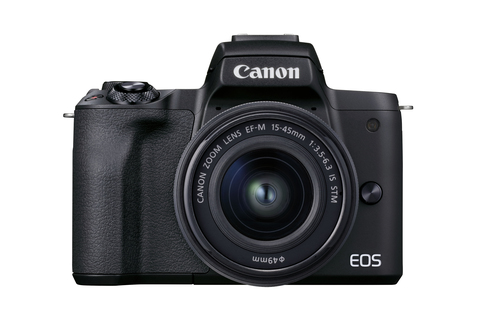
Canon EOS M50 Mark II MILC 24.1 MP CMOS 6000 x 4000 pixels Black
- Product colour: Black
- Display: TFT
- Video recording
- Maximum video resolution: 3840 x 2160 pixels
- Camera type: MILC
- Megapixel (approx.): 24.1 MP
Versions
 MILC
 MILC Body
Where to buy
We're not tracking prices for this product yet. Check current prices directly at:
We may earn a commission when you buy through links on this page — at no extra cost to you. Learn more
Documents
- ManualUser manual ↗
Specifications
Key specifications
- Product colourThe colour e.g. red, blue, green, black, white.
- Black
- DisplayThe description of display that can includes display type, resolution, size etc.
- TFT
- Video recordingRecording moving visual images.
- Yes
- Maximum video resolutionThis is the maximum resolution of video images. Resolution is a measure of the degree of detail visible.
- 3840 x 2160 pixels
- Camera typeThere are a number of common types of digital cameras: compact cameras, bridge cameras, mirrorless interchangeable-lens cameras (MILC) and single lens reflex (SLR) cameras. Bridge cameras 'bridge the gap' between the low-end compact and high-end professional (SLR) cameras. Also MILCs populate this mid-segment by combining the larger sensors and interchangeable lenses of DSLRs with the live-previe…
- MILC
- Megapixel (approx.)The number (in millions) of light-sensitive picture elements known as pixels actually used by the camera's image sensor (CCD) to record light, and which are reflected to the final number of recorded pixels stored on the memory card.
- 24.1 MP
- Sensor typeA sensor is a convertor than measures a physical quality (light, temperature etc.) and displays this electronically on a device.
- CMOS
- Maximum image resolutionResolution is the amount of detail held by an image. The higher the resolution, the better (sharper) the image. The maximum image resolution produces the best image.
- 6000 x 4000 pixels
- Video compression formatsThe video encoding standards supported by the device for reducing file size and bandwidth usage (e.g. AV1, AVC, AVCHD).
- MPEG4
- Neck strap includedIndicates whether a strap for carrying the device around the neck is provided in the package.
- Yes
Show all 120 specificationsShow key specifications only
Design
- Product colourThe colour e.g. red, blue, green, black, white.
- Black
Display
- DisplayThe description of display that can includes display type, resolution, size etc.
- TFT
- TouchscreenA screen of a laptop, smartphone, etc., that responds to touch so you can control the interface using your fingers.
- Yes
- Display diagonalSize of the display for this product, measured diagonally, usually in inches.
- 7.62 cm (3")
- Display resolutionThe number of distinct pixels in each dimension that can be displayed. It is usually quoted as width × height, with the units in pixels: for example, "1024 × 768" means the width is 1024 pixels and the height is 768 pixels. The higher the number of pixels, the sharper the image.
- 1040000 dot
- Display aspect ratioThe proportional relationship between the width and the height of the image or screen (e.g. 16:9).
- 3:2
- Vari-angle LCD displayIndicates whether the device features a screen that can be tilted and rotated to various angles for flexible framing.
- Yes
- Field of viewThe extent of the observable world that is seen at any given moment, expressed as a percentage.
- 100%
- HD typeType of supported High Definition (e.g. Full HD, 4K Ultra HD).
- 4K Ultra HD
Camera
- Video recordingRecording moving visual images.
- Yes
- Maximum video resolutionThis is the maximum resolution of video images. Resolution is a measure of the degree of detail visible.
- 3840 x 2160 pixels
- White balanceTechnique in photography and image processing, which involves a global adjustment of the intensities of the colors (typically red, green, and blue primary colors). An important goal of this adjustment is to render specific colors – particularly neutral colors including white – correctly.
- Auto, Daylight, Direct sunlight, Fluorescent, Tungsten
- Scene modesScenery mode', 'Portrait mode' and other modes which are manually/automatically activated on a camera and change the settings (e.g. exposure time) accordingly.
- Beach, Children, Close-up (macro), Dawn, Fireworks, Landscape, Monochrome, Night, Party (indoor), Portrait, Self-portrait, Sunrise, Sunset, Twilight
- Shooting modesThe predefined capture settings available for different lighting or subject conditions.
- Aperture priority, Auto, Manual, Program, Scene, Shutter priority
- Photo effectsDifferent effects that you can use to modify photos after they have been taken, such as colour filters.
- Black&White
- Self-timer delayDuration of self-timer, that's a camera device that gives a delay between pressing the shutter release and the shutter's firing. It is most commonly used to let photographers to take a photo of themselves (often with the family), hence the name.
- 10 s
- Camera playbackThe available modes for reviewing captured media on the device, such as viewing a slide show or individual thumbnails.
- Single image, Slide show
- Playback zoom (max)The maximum magnification level available when viewing captured images or videos on the screen.
- 15x
- Custom colourIndicates whether the device allows the user to define and save their own custom colour profiles.
- No
- HistogramIndicates whether the device provides a graphical representation of the tonal distribution to help evaluate exposure.
- Yes
- Live viewIndicates whether the device supports the real-time transmission of a video feed to a connected display or monitoring interface.
- Yes
- Camera file systemThe standard used by the device to organize and store image and video files on the memory medium (e.g. DCF).
- Raw
- Multi-shotIndicates whether the device can capture multiple images in rapid succession to be combined or selected later.
- Yes
- Tripod mounting supportedIndicates whether the device has a threaded socket for attachment to a tripod.
- Yes
- Resolution at capture speedThe pixel dimensions of the image or video frame recorded at a specific frame rate (e.g. 1024x768@30fps).
- 3840x2160@24fps, 3840x2160@25fps
- Camera shutter typeIndicates if the camera shutter is mechanical or electronic.
- Electronic
- Digital zoomIndicates the digital zoom capacity, the number of times that the picture is enlarged thanks to digital technology.
- 1x
- Image stabilizerThis camera function compensates for slight shaking movements caused by an unstable position and ensures smooth footage even in suboptimal conditions.
- Yes
- Total megapixelsA megapixel (MP or Mpx) is one million pixels, and is a term used not only for the number of pixels in an image, but also to express the number of image sensor elements of digital cameras or the number of display elements of digital displays. For example, a camera that makes a 2048 × 1536 pixel image typically uses a few extra rows and columns of sensor elements and is commonly said to have "3.2…
- 25.8 MP
Picture quality
- Camera typeThere are a number of common types of digital cameras: compact cameras, bridge cameras, mirrorless interchangeable-lens cameras (MILC) and single lens reflex (SLR) cameras. Bridge cameras 'bridge the gap' between the low-end compact and high-end professional (SLR) cameras. Also MILCs populate this mid-segment by combining the larger sensors and interchangeable lenses of DSLRs with the live-previe…
- MILC
- Megapixel (approx.)The number (in millions) of light-sensitive picture elements known as pixels actually used by the camera's image sensor (CCD) to record light, and which are reflected to the final number of recorded pixels stored on the memory card.
- 24.1 MP
- Maximum image resolutionResolution is the amount of detail held by an image. The higher the resolution, the better (sharper) the image. The maximum image resolution produces the best image.
- 6000 x 4000 pixels
- Still image resolution(s)List of image resolutions that supported by device.
- RAW: 6000 x 4000 JPEG 3:2: (L) 6000 x 4000, (M) 3984 x 2656, (S1) 2976 x 1984, (S2) 2400 x 1600 JPEG 4:3: (L) 5328 x 4000, (M) 3552 x 2664, (S1) 2656 x 1992, (S2) 2112 x 1600 JPEG 16:9: (L) 6000 x 3368, (M) 3984 x 2240, (S1) 2976 x 1680 (S2) 2400 x 1344 JPEG 1:1: (L) 4000 x 4000, (M) 2656 x 2656, (S1) 1984 x 1984, (S2) 1600 x 1600
- Image stabilizer locationSpecifies whether the image stabilization mechanism is integrated into the camera body or located within the lens (e.g., Lens).
- Lens
- Image sensor size (W x H)The physical dimensions of the light-sensitive area of the image sensor, measured in mm.
- 22.3 x 14.9 mm
- Sensor formatThe physical size and standard of the image sensor, such as Full-frame or APS-C.
- Full-frame
Image sensor
- Sensor typeA sensor is a convertor than measures a physical quality (light, temperature etc.) and displays this electronically on a device.
- CMOS
Performance
- Video compression formatsThe video encoding standards supported by the device for reducing file size and bandwidth usage (e.g. AV1, AVC, AVCHD).
- MPEG4
- Built-in processorWhether or not a processor is built into the device.
- Yes
- Video formats supportedThe type of video formats that can be used by this device.
- MPEG4
- Image formats supportedThe type of image files that the device can use/display e.g. gif, JPEG (jpg).
- JPEG, Raw
Packaging content
- Neck strap includedIndicates whether a strap for carrying the device around the neck is provided in the package.
- Yes
- Power cord includedIndicates whether a power cable is supplied with the product.
- Yes
- AC adapter includedIndicates whether a power supply unit for connecting the device to an AC outlet is provided in the package.
- Yes
- Battery charger includedIndicates whether a battery charger is supplied with the product.
- Yes
- Batteries includedIndicates whether the required batteries are supplied with the product.
- Yes
- Carrying caseA case in which the product can be carried.
- Yes
- Quick start guideInstructions, either online, as a computer program or in paper form, to allow you to set up and start using the product quickly.
- Yes
- User guideIndicates whether a user manual or instructional guide is included with the product.
- Yes
Features
- Shoulder strapIndicates whether the product includes a strap for carrying the unit over the shoulder.
- Yes
- MaterialThe material from which a thing is or can be made e.g. wood, plastic.
- Polycarbonate (PC)
- Country of originCountry where the device is made. Aka Country of manufacture (COM).
- Japan
Weight & dimensions
- WidthThe measurement or extent of something from side to side.
- 116.3 mm
- DepthThe distance from the front to the back of something.
- 58.7 mm
- HeightThe measurement of the product from head to foot or from base to top.
- 88.1 mm
- WeightWeight of the product without packaging (net weight). If possible, the net weight is given including standard accessories and supplies. Please note that sometimes the manufacturer leaves out the weight of accessories and/or supplies.
- 387 g
- Weight (including battery)The total weight of the device with its battery, given in kilogram (kg).
- 528 g
- Lens diameterThe size of the lens, measured by drawing a straight line from one side to the other, going through the centre of the lens.
- 4.9 cm
- Lens lengthThe physical length of the lens assembly, typically measured in millimetres.
- 13 cm
Operational conditions
- Operating temperature (T-T)The minimum and maximum temperatures at which the product can be safely operated.
- 0 - 40 °C
- Operating relative humidity (H-H)The range of relative humidity, expressed as a percentage, within which the device can function correctly without damage or performance loss.
- 0 - 85%
Battery
- Battery technologyThe type of battery in the device, e.g. nickel–cadmium (NiCd).
- Lithium-Ion (Li-Ion)
- Battery voltageThe voltage (V) of the battery.
- 7.2 V
- Battery life (CIPA standard)The estimated duration of operation or number of cycles possible on a single full charge of the battery, based on CIPA standard measurements.
- 250 shots
- Battery capacityA measure of the charge stored by the battery. Determined by the mass of active material contained in the battery.
- 875 mAh
- Video recording timeThe maximum duration the device can continuously record video on a single charge or storage capacity, measured in h.
- 30 min
Power
- Number of batteries supportedThe number of batteries that can be used with the product.
- 1
Other features
- SlideshowIndicates whether the device has a built-in function to automatically display a sequence of stored images.
- Yes
Network
- BluetoothBluetooth is a low-power radio technology developed to replace the cables and wires currently used to link or connect electronic devices such as personal computers, printers, and a wide variety of handheld devices including mobile phones. Because it uses radio-wave connectivity, a Bluetooth-enabled device has a constant, established connection to whatever browser it uses. This saves the user the…
- Yes
- Bluetooth versionThe type of bluetooth technology in the product e.g. Bluetooth Smart (v4.0).
- 4.2
- Bluetooth Low Energy (BLE)Indicates whether the device supports Bluetooth Low Energy for power-efficient wireless communication.
- Yes
- Wi-FiPopular technology that allows an electronic device to exchange data or connect to the internet wirelessly using radio waves.
- Yes
- Wi-Fi standardsThe type of wireless local area network (LAN). It can be ad-hoc, where units in a network communicate peer-to-peer, or Infrastructure, where units communicate with each other via an access point A LAN interconnects computers in a small area e.g. home, school or office.
- 802.11b, 802.11g, Wi-Fi 4 (802.11n)
- Near Field Communication (NFC)Indicates whether the device supports short-range wireless connectivity for exchanging data between devices in close proximity.
- No
Ports & interfaces
- PictBridgePictBridge is an industry standard introduced in 2003 from the Camera & Imaging Products Association (CIPA) for direct printing. It allows images to be printed directly from digital cameras to a printer, without having to connect the camera to a computer using common connectivity like USB or Bluetooth.
- Yes
- USB connectorWhat type of USB connector is built into the device.
- Micro-USB
- HDMIHDMI (High-Definition Multimedia Interface) is a compact audio/video interface for transferring uncompressed video data and compressed/uncompressed digital audio data from a HDMI-compliant device ("the source device") to a compatible computer monitor, video projector, digital television, or digital audio device. HDMI is a digital replacement for existing analog video standards.
- Yes
- HDMI connector typeThe physical size and form factor of the HDMI port on the device (e.g. Full-size, Mini, or Micro).
- Micro
Viewfinder
- Viewfinder typeA viewfinder is the window in the camera through which a photographer views the picture. Used for choosing, composing, and often focusing the image. There are two types: optical and digital. In an optical viewfinder, the photographer looks through a transparent window to frame and focus the image. The photographer is seeing the real image, through the window of the viewfinder. With a digital view…
- Electronic
- Viewfinder resolution (approx.)The number of pixels that make up the image displayed in the viewfinder, typically expressed as width x height (e.g. 1024 x 768).
- 2360000 pixels
Storage
- Compatible memory cardsTypes of memory cards which can be used with this product.
- SD, SDHC, SDXC
Memory
- Memory slotsNumber and type of memory expansion slots, including connector and memory module descriptions.
- 1
Audio
- Audio systemSystem used to play music or speech.
- stereo
Flash
- Flash modesDifferent modes for a camera flash which are manually/automatically activated e.g. auto-flash mode, flash on with red eye reduction.
- Auto, High-speed synchronization, Manual, Red-eye reduction, Second curtain synchro
- Flash exposure lockIndicates whether the device allows the user to lock the flash exposure settings to maintain consistent lighting across multiple shots.
- Yes
- Flash guide numberThe guide number for an electronic flash measures its ability to illuminate the subject to be photographed at a specific film or sensor sensitivity and angle of view. A higher guide number indicates a more powerful flash.
- 5 m
- Flash recharging timeThe time required for the flash unit to fully recharge between consecutive shots, measured in seconds.
- 3 s
- Flash sync-speedThe fastest shutter speed at which the device can synchronize with an external flash, measured in s.
- 1/200 s
- Flash exposure compensationIndicates whether the device allows the user to manually adjust the brightness of the flash relative to the light meter's reading.
- Yes
- Flash exposure correctionThe range and increment steps available to manually adjust the brightness of the flash output, measured in exposure values (e.g., -2EV to +1EV).
- ±2EV (1/3 EV step)
Shutter
- Fastest camera shutter speedThe minimum time which the camera shutter is open when taking a photo.
- 1/4000 s
- Slowest camera shutter speedThe maximum time which the camera shutter is open when taking a photo.
- 0.00025 s
Exposure
- ISO sensitivity (min)The lowest level of light sensitivity that can be set, measured in ISO units.
- 100
- ISO sensitivity (max)The maximum level of sensor sensitivity to light, measured in ISO (e.g., 6400).
- 25600
- Light exposure modesThe different lengths of time for the exposure for a camera e.g. longer exposure for low light.
- Aperture priority AE, Auto, Manual, Shutter priority AE
- Light exposure controlThe method used by the device to regulate the amount of light reaching the sensor or recording medium to achieve correct exposure (e.g. Program AE).
- Program AE
- Light exposure correctionThe range and increments by which the user can manually adjust the brightness of an image to compensate for lighting conditions (e.g., ± 2EV in 1/3EV steps).
- ± 3EV (1/3EV step)
- Auto Exposure (AE) lockIndicates whether the device can lock the exposure settings to prevent them from changing automatically during a shot.
- Yes
- Number of measurement zonesThe total number of individual areas the image sensor uses to evaluate light levels for exposure calculation.
- 384
- Low light sensitivityIndicates whether the device is specifically designed to capture clear images in environments with minimal illumination.
- Yes
Focusing
- Focus adjustmentThe range or specific value at which the device can be adjusted to achieve a sharp image of the subject (e.g. 1.2 - 2.0).
- Auto/Manual
- Auto focusing (AF) modesModes on the camera for auto-focusing, including continuous focusing and one shop focusing.
- Area Auto Focus, Centre weighted Auto Focus, Multi Point Auto Focus, One Shot Focus, Single Auto Focus, Tracking Auto Focus
- Auto Focus (AF) object detectionSpecifies the types of subjects the device can automatically recognize and track to maintain sharp focus (e.g. Animal, Eye, or Face).
- Face
- Face trackingIndicates whether the device can automatically detect and follow a human face to keep it in focus or centered in the frame.
- Yes
- Auto Focus (AF) points selectionThe method used to determine which focus points are active, such as automatic selection by the device or manual selection by the user.
- Auto, Manual
- Auto Focus (AF) assist beamIndicates whether the device projects a beam of light to help the autofocus system lock onto a subject in low-light conditions.
- Yes
Lens system
- Optical zoomIndicates the optical zoom capacity, which is the number of times that the picture can be enlarged with the optics of the camera.
- 3x
- Focal length rangeMeasure of how strongly the system converges or diverges light. For an optical system in air, it is the distance over which initially collimated rays are brought to a focus. A system with a shorter focal length has greater optical power than one with a long focal length; that is, it bends the rays more strongly, bringing them to a focus in a shorter distance.For an optical system in air, the effe…
- 45 mm
- Minimum focal length (35mm film equiv)The minimum 35mm equivalent focal length, which is a measure that indicates the angle of view of a particular combination of a camera lens and film or sensor size. The term is useful because most photographers experienced with interchangeable lenses are most familiar with the 35mm film format.
- 24 mm
- Maximum focal length (35mm film equiv)The maximum 35mm equivalent focal length, which is a measure that indicates the angle of view of a particular combination of a camera lens and film or sensor size. The term is useful because most photographers experienced with interchangeable lenses are most familiar with the 35mm film format.
- 72 mm
- Maximum aperture numberThe largest opening, expressed as an f-number, which determines the maximum amount of light that can pass through to the sensor.
- 3.5
- Lens typeCategory of lens e.g. tele, close-up, macro.
- Standard zoom
- Number of diaphragm bladesThe total count of overlapping blades in the lens aperture that control the amount of light reaching the sensor and influence the shape of the bokeh.
- 7
- Lens mount interfaceA lens mount is an interface — mechanical and often also electrical — between a photographic camera body and a lens. It is confined to cameras where the body allows interchangeable lenses, most usually the rangefinder camera, single lens reflex type or any movie camera of 16 mm or higher gauge.
- Canon EF-M
Projector
- Supported aspect ratiosThe aspect ratio is the ratio of the width of an image to its height. The supported aspect ratios are the aspect ratios that can be shown by the device.
- 1:1, 2:3, 3:2, 3:4, 4:3, 16:9
Packaging data
- Package widthThe distance from one side of the packaging to the other.
- 290 mm
- Package depthThe distance from the front to the back of the packaging.
- 219 mm
- Package heightThe distance from the top to the bottom of the packaging.
- 197 mm
- Package volumeThe total space occupied by the product including its packaging, typically measured in cubic centimetres or cubic metres.
- 125 cm³
- Package weightWeight of the packaged product.
- 2.21 kg
Database Right data-sheet 2026 Icecat. All rights reserved. Provided “as is”, without warranty — check details with the store before buying.
Expert reviews
- 80
amateurphotographer.co.uk2021
I cant recall reviewing a camera that has had such minor changes and yet required a whole new model rather than a firmware update. Whilst the new features are welcome additions, particularly Eye AF, those who have needed those features may have already o...
- +
- Small and lightweight body, Good image quality, Proven technology such as Dual Pixel AF, Eye AF
- −
- Only minor improvements over the original, No sensor-based image stabilisation, Limited native lens line-up
- 70
techradar.com2021
Canon's EOS M50 Mark II is a confusing little camera – while it is feature-packed, it's only a very minor update on the first EOS M50 camera. Other than the addition of eye AF and the ability to shoot vertical video, there's not really a whole lot differe...
- +
- Vertical video recording, Eye AF for stills and video, Great stills
- −
- Heavily cropped 4K video, Limited native lenses, 100fps shooting at only 720p
Price history (90 days, best daily price)
Price history is still being collected for this product — check back soon.
Alternative models

Canon EOS RP
MILC Body 26.2 MP CMOS 6240 x 4160 pixels Black

Canon EOS M50 Mark II + M15-45 S+M55-200 EU26
MILC 24.1 MP CMOS 6000 x 4000 pixels Black

Canon EOS R
MILC 30.3 MP CMOS 6720 x 4480 pixels Black

Canon EOS M50 Mark II
MILC 24.1 MP CMOS 6000 x 4000 pixels Black

Canon PowerShot ZOOM 1/3"
Compact camera 12.1 MP CMOS 4000 x 3000 pixels White

Canon EOS M50 Mark II + M18-150 EU26
MILC 24.1 MP CMOS 6000 x 4000 pixels Black