
ASUS PRO WS W680M-ACE SE Intel W680 LGA 1700 micro ATX
- Socket: LGA 1700
- Chipset: Intel W680
- Form factor: micro ATX
- Memory: 4 × DDR5-SDRAM, up to 192 GB
- Storage: 2 × M.2, 4 × SATA III
- Network: 2.5 Gigabit Ethernet, Gigabit Ethernet
Where to buy
We're not tracking prices for this product yet. Check current prices directly at:
We may earn a commission when you buy through links on this page — at no extra cost to you. Learn more
About this product
WORKSTATION MOTHERBOARD
ASUS Pro Workstation motherboards are designed for professionals in AI training, deep learning, animation, 3D rendering or media production. Featuring expandable graphics, extensive storage, impressive connectivity and exceptional overall performance and reliability, Pro Workstation motherboards are the ideal solution for creative professionals. Each motherboard includes centralized management software, so they're also an efficient and cost-effective option for IT administrators.
Ultra Powerful Back IO
The motherboard comes with four USB 3.2 Gen 1 type connector, one reversible USB Type-C connector and front-panel connectors to support additional USB expansions.
ECC Memory Support
Designed for creative professionals who require outstanding performance, reliability and enhanced security, ASUS Pro WS W680M-ACE SE motherboard is powered by the latest 13th and 12th Gen Intel processors for always-on usage scenarios and supports ECC memory to automatically detect and correct data corruption, reducing the chance of system crashes to ensure workstation stability.
Dual 2.5G Ethernet
Boosted connectivity with dual onboard Ethernet ports. Intel 2.5G Ethernet upgrades your traditional LAN connection with an up to 2.5X bandwidth improvement. Using your existing Ethernet cable, you can experience faster file transfers and immediately stream high-resolution videos.
BMC remote management
An integrated BMC (Baseboard Management Controller) is a key feature for workstations. It uses a 1G Realtek controller, with one 1G port dedicated to the BMC to provide the intelligence for its IPMI architecture. The BMC manages the interface between system-management software and platform hardware. Administrators can remotely communicate with the BMC to take some corrective actions — such as resetting or power cycling a system.
ASUS Control Center Express
The best business performance requires smart IT management. ASUS Control Center Express is an intuitive and secure software designed to simplify IT operations and improve workload productivity by providing comprehensive control of all the systems in your organization. Plus, ASUS Control Center Express is compatible with over 100 ASUS motherboards to give you more upgrade flexibility and less compatibility issues.
Two M.2 & SlimSAS storage
Two PCIe 4.0 M.2 slots are available to run smoothly among PCIe 4.0 SSD storage devices. Users who are working with massive files can RAID together multiple NVMe devices for more I/O bandwidth and seamless playback in their editing bays. One SlimSAS port connects to SlimSAS device among PCIe 4.0 x4 channel to support up to 4 SATA devices via a transfer cable which support SATA RAID 0,1,5, and 10. *These features require Intel Rapid storage technology and Intel Optane Memory H Series on PCH attached M.2 slots
Thermal Solution
VRM heatsink
A large, dedicated heatsink with extensive surface that covers the VRM and choke areas improves heat dissipation.
PCH heatsink
An expanded surface area for the chipset cooler maximizes performance and heat dissipation.
M.2 heatsink
M.2 slot has a dedicated heatsink keep the M.2 SSD at optimum operating temperature to ensure consistent performance and reliability.
Q-Latch
The innovative Q-Latch makes it easy to install or remove an M.2 SSD without the need for specific tools. The design employs a simple locking mechanism to secure the drive and neatly eliminate traditional screws.
SafeSlot & SafeDIMM
PCIe 5.0 is 2x faster than PCIe 4.0, so we adapted our SMT manufacturing process for the faster SafeSlot, to ensure the highest data speeds. SafeSlot is a reinforced metal sheath added to a PCIe slot to keep a card firmly installed. Meanwhile, strong ASUS SafeDIMM sheathes support and protect memory modules on select ASUS motherboards, empowering you to insert your modules with speed, accuracy and confidence.
24/7 Dependability
Optimized for 24/7 operation, Pro WS W680M-ACE SE motherboard is tested to work in temperatures of up to 45°C and 80% humidity, ensuring it can handle diverse operating environments.
Solid Compatibility Validation
ASUS Pro WS W680M-ACE SE motherboard has been extensively tested for compatibility with over 1,000 components and devices. Each new ASUS motherboard model undergoes a minimum of 8,000 hours of strict tests so that you can be 100% confident it is suitable for all environments and applications.
Documents
- ManualUser manual ↗
Specifications
Key specifications
- Processor socketMechanical component(s) that provides mechanical and electrical connections between a microprocessor and a printed circuit board (PCB). This allows the processor to be replaced without soldering.
- LGA 1700
- Motherboard chipsetThe chipset connects the microprocessor to the rest of the motherboard.
- Intel W680
- Motherboard chipset familyThe category of motherboard chipset e.g. Intel, AMD.
- Intel
- Motherboard form factorDesign of the motherboard (ATX, BTX etc).
- micro ATX
- Number of memory slotsThe total number of available sockets for installing memory modules.
- 4
- Supported memory typesTypes of memory which can be used with the product.
- DDR5-SDRAM
- Maximum internal memoryThe maximum amount of memory inside a product, usually measured in bytes e.g megabytes (MB) or gigabytes (GB).
- 192 GB
- Number of M.2 (M) slotsThe total number of available M.2 M-key slots for installing high-speed storage devices or expansion cards.
- 2
- Number of SATA III connectorsSerial ATA (Advanced Technology Attachment) (SATA) is a computer bus interface that connects host bus adapters to mass storage devices such as hard disk drives and optical drives. SATA III (revision 3.x) interface, formally known as SATA 6Gb/s, is a third generation SATA interface running at 6.0Gb/s. The bandwidth throughput, which is supported by the interface, is up to 600MB/s. This interface i…
- 4
- Ethernet interface typeThe maximum data transfer rate supported by the network port, expressed in gigabits per second (e.g., 10 Gigabit Ethernet).
- 2.5 Gigabit Ethernet, Gigabit Ethernet
Show all 71 specificationsShow key specifications only
Features
- Component forWhat this product is used as a part of (component for).
- PC
- Motherboard form factorDesign of the motherboard (ATX, BTX etc).
- micro ATX
- Motherboard chipset familyThe category of motherboard chipset e.g. Intel, AMD.
- Intel
- Windows operating systems supportedWindows vesions wich can be used with the device.
- Windows 10, Windows 11
Memory
- Supported memory typesTypes of memory which can be used with the product.
- DDR5-SDRAM
- Number of memory slotsThe total number of available sockets for installing memory modules.
- 4
- Memory slots typeA memory slot, also known as a memory socket or RAM slot, is what allows computer memory (RAM) to be inserted into the computer. Depending on the motherboard, there will usually be 2 to 4 memory slots (sometimes more on high-end motherboards). The most common types of RAM are SDRAM and DDR for desktop computers and SODIMM for laptop computers, each having various types and speeds.
- DIMM
- Memory channelsThe number of communication paths between the memory controller and the RAM, which affects data transfer bandwidth (e.g., Dual-channel).
- Dual-channel
- ECC сompatibilitySpecifies whether the product supports Error Correction Code (ECC) memory, which detects and fixes data corruption (e.g., ECC, non-ECC).
- Non-ECC
- Maximum internal memoryThe maximum amount of memory inside a product, usually measured in bytes e.g megabytes (MB) or gigabytes (GB).
- 192 GB
- Unbuffered memoryIndicates whether the device supports the use of unbuffered memory modules.
- Yes
Processor
- Processor manufacturerThe manufacturer that produced the processor.
- Intel
- Processor socketMechanical component(s) that provides mechanical and electrical connections between a microprocessor and a printed circuit board (PCB). This allows the processor to be replaced without soldering.
- LGA 1700
- Compatible processor seriesA processor which is compatible with this device, belongs to a 'series' which is part of 'family' e.g Celeron D, Celeron G, Celeron M, or, in some cases, is the same as 'family'.
- Intel Core i3, Intel Core i5, Intel Core i7, Intel Core i9
- Parallel processing technology supportParallel processing technology is the simultaneous use of more than one CPU or processor core to execute a program or multiple computational threads. Ideally, parallel processing makes programs run faster because there are more engines (CPUs or Cores) running it. In practice, it is often difficult to divide a program in such a way that separate CPUs or cores can execute different portions without…
- Not supported
- Supported processor socketsThe sockets (plugs) for processors that are supported (can be used) by the device.
- LGA 1700
Weight & dimensions
- WeightWeight of the product without packaging (net weight). If possible, the net weight is given including standard accessories and supplies. Please note that sometimes the manufacturer leaves out the weight of accessories and/or supplies.
- 820 g
- WidthThe measurement or extent of something from side to side.
- 244 mm
- DepthThe distance from the front to the back of something.
- 244 mm
Other features
- Back-to-BIOS buttonIndicates whether the product features a dedicated physical button to enter the BIOS setup utility without needing a keyboard.
- Yes
Packaging content
- Cables includedSpecifies the types and quantities of connection cables provided with the product (e.g., 3.5 mm to 3.5 mm or SATA).
- SATA
- User guideIndicates whether a user manual or instructional guide is included with the product.
- Yes
BIOS
- BIOS typeThe BIOS (Basic Input/Output System) initializes and tests system hardware components, and loads a bootloader or an operating system from a mass memory device. The BIOS additionally provides abstraction layer for the hardware, i.e. a consistent way for application programs and operating systems to interact with the keyboard, display, and other input/output devices. There are several types of BIOS…
- UEFI AMI
- BIOS memory sizeThe total storage capacity of the basic input/output system chip, measured in Mbit.
- 256 Mbit
Expansion slots
- PCI Express x1 (Gen 3.x) slotsThe number of available PCI Express x1 slots supporting generation 3.x specifications for expanding the device's functionality.
- 1
- PCI Express x4 (Gen 4.x) slotsThe number of expansion slots available that support the PCI Express 4.0 standard with x4 lane connectivity.
- 1
- PCI Express x16 (Gen 5.x) slotsThe number of available PCI Express x16 slots supporting the 5.0 generation standard for high-speed component connectivity.
- 1
- Number of M.2 (M) slotsThe total number of available M.2 M-key slots for installing high-speed storage devices or expansion cards.
- 2
Performance
- Motherboard chipsetThe chipset connects the microprocessor to the rest of the motherboard.
- Intel W680
- Audio output channelsAn audio output channel is an electric circuit which acts as a path for a signal produced by a device. A device may have several audio output channels.
- 7.1 channels
- Ethernet interface typeThe maximum data transfer rate supported by the network port, expressed in gigabits per second (e.g., 10 Gigabit Ethernet).
- 2.5 Gigabit Ethernet, Gigabit Ethernet
Design
- Cooling typeThe method used to cool the device or to cool the air around the device.
- Passive
Power
- Power source typeWhat the power source is.
- ATX
Network
- Ethernet LANAn Ethernet LAN (Local Area Network) interface is present, for a wired conection via a cable.
- Yes
- Wi-FiPopular technology that allows an electronic device to exchange data or connect to the internet wirelessly using radio waves.
- No
Ports & interfaces
- USB 3.2 Gen 1 (3.1 Gen 1) Type-A ports quantityThe total number of available USB 3.2 Gen 1 (formerly 3.1 Gen 1) Type-A connection ports on the device.
- 4
- USB 3.2 Gen 2 (3.1 Gen 2) Type-A ports quantityThe total number of USB Type-A ports that support the 3.2 Gen 2 (formerly 3.1 Gen 2) standard for high-speed data transfer.
- 1
- USB 3.2 Gen 2 (3.1 Gen 2) Type-C ports quantityNumber of USB 3.1 (3.1 Gen 2) ports with Type-C connector. USB 3.1 (3.1 Gen 2) is USB interface version which supports transfer rate up to 10 Gbit/s (SuperSpeed+). USB Type-C connector has symmetrical design architecture and compatible with Thunderbolt 3 interface.
- 1
- Ethernet LAN (RJ-45) portsNumber of Ethernet LAN (RJ-45) ports (connecting interfaces) in the device. Ethernet LAN (RJ-45) ports allow a computer to connect to the ethernet.
- 3
- VGA (D-Sub) ports quantityNumber of VGA (D-Sub) ports (connecting interfaces) in the device. The VGA (D-Sub) connector is a 15 pin connector between a computer and a monitor. It was first introduced in 1987 by IBM.
- 1
- HDMI ports quantityThe number of sockets (ports) for HDMI connections. HDMI (High-Definition Multimedia Interface) is a compact audio/video interface for transferring uncompressed video data and compressed/uncompressed digital audio data from a HDMI-compliant device ("the source device") to a compatible computer monitor, video projector, digital television, or digital audio device. HDMI is a digital replacement for…
- 1
- HDMI versionThe specific release version of the High-Definition Multimedia Interface standard supported by the device (e.g. 1.3 or 2.0).
- 2.1
- DisplayPorts quantityNumber of DisplayPorts. A DisplayPort is a digital display interface developed by the Video Electronics Standards Association (VESA). The interface is primarily used to connect a video source to a display device such as a computer monitor, though it can also be used to carry audio, USB, and other forms of data.
- 1
- DisplayPort versionThe specific release version of the DisplayPort standard supported by the device (e.g., 1.2 or 1.4).
- 1.4
- Headphone outputsNumber of sockets /ports where headphones are connected.
- 1
- Line-inIndicates whether the device has a dedicated input port for receiving audio signals from an external source.
- Yes
- Number of SAS portsThe total number of Serial Attached SCSI (SAS) interfaces available on the product for connecting storage devices.
- 1
- Number of SATA III connectorsSerial ATA (Advanced Technology Attachment) (SATA) is a computer bus interface that connects host bus adapters to mass storage devices such as hard disk drives and optical drives. SATA III (revision 3.x) interface, formally known as SATA 6Gb/s, is a third generation SATA interface running at 6.0Gb/s. The bandwidth throughput, which is supported by the interface, is up to 600MB/s. This interface i…
- 4
Internal I/O
- USB 2.0 connectorsThe end of a cable with a USB 2.0 connector. USB 2.0 was released in April 2000 (now called "Hi-Speed"), adding higher maximum signaling rate of 480 Mbit/s (effective throughput up to 35 MB/s or 280 Mbit/s), in addition to the "USB 1.x Full Speed" signaling rate of 12 Mbit/s. USB 2.0 connectors are usually colored black.
- 2
- USB 3.2 Gen 1 (3.1 Gen 1) connectorsThis is a connector (normally attached to a cable) for USB 3.0. USB 3.0 is the second major revision of the Universal Serial Bus (USB) standard for computer connectivity. First introduced in 2008, USB 3.0 adds a new transfer mode called "SuperSpeed," (distinguishable from USB 2.0 by either the blue colour of the port or the initials SS) capable of transferring data at up to 5Gbit/s—more than ten…
- 1
- USB 3.2 Gen 2 (3.1 Gen 2) connectorsThe total number of internal or external ports supporting the USB 3.2 Gen 2 (3.1 Gen 2) standard for high-speed data transfer.
- 1
- Audio connectorIndicates whether the product features a dedicated interface for connecting audio devices.
- Yes
- Front panel connectorIndicates whether the product has a dedicated header for connecting the chassis front panel buttons and LEDs.
- Yes
- ATX Power connector (24-pin)Indicates whether the product features a 24-pin ATX power connector for main power supply connectivity.
- Yes
- CPU fan connectorIndicates whether the product has a dedicated header for connecting a CPU cooling fan.
- Yes
- Number of chassis fan connectorsThe total number of internal headers available to connect case cooling fans (e.g. 3 or 4).
- 3
- Chassis intrusion connectorIndicates whether the product has a dedicated header to connect a switch that detects when the case has been opened.
- Yes
- EPS power connector (8-pin)Indicates whether the product features an 8-pin EPS connector to provide dedicated power to the CPU.
- Yes
- Number of COM connectorsThe total number of serial communication ports available on the device (e.g. 2).
- 1
- TPM connectorIndicates whether the product features a dedicated header for connecting a Trusted Platform Module (TPM) security chip.
- Yes
- 12V power connectorIndicates whether the product has a dedicated 12V power connector for additional power delivery.
- Yes
Storage
- Supported storage drive typesThe type of storage drives the device is compatible with.
- HDD & SSD
- Supported storage drive interfacesThe physical and logical connection standards supported for connecting storage drives to the system (e.g., M.2 or SATA).
- M.2, NVMe, PCI Express 4.0, SATA III, SlimSAS
- Number of HDDs supportedThe total number of hard drives that can be used in/with this product.
- 8
- Number of storage drives supportedHow many storage drives can be fit into the product at once.
- 10
- RAID supportThe device uses RAID, which is a storage technology that combines multiple disk drive components into a logical unit for the purposes of data redundancy and performance improvement. Data is distributed across the drives in one of several ways, referred to as RAID levels, depending on the specific level of redundancy and performance required.
- Yes
- RAID levelsRAID is a storage technology that combines multiple disk drive components into a logical unit for the purposes of data redundancy and performance improvement. Data is distributed across the drives in one of several ways, referred to as RAID levels, depending on the specific level of redundancy and performance required.
- 0, 1, 5, 10
Packaging data
- Package widthThe distance from one side of the packaging to the other.
- 275 mm
- Package depthThe distance from the front to the back of the packaging.
- 275 mm
- Package heightThe distance from the top to the bottom of the packaging.
- 67.5 mm
- Package weightWeight of the packaged product.
- 1.35 kg
Database Right data-sheet 2026 Icecat. All rights reserved. Provided “as is”, without warranty — check details with the store before buying.
Price history (90 days, best daily price)
Price history is still being collected for this product — check back soon.
Alternative models

ASUS PRO H610T-CSM
Intel H610 LGA 1700 Thin Mini ITX
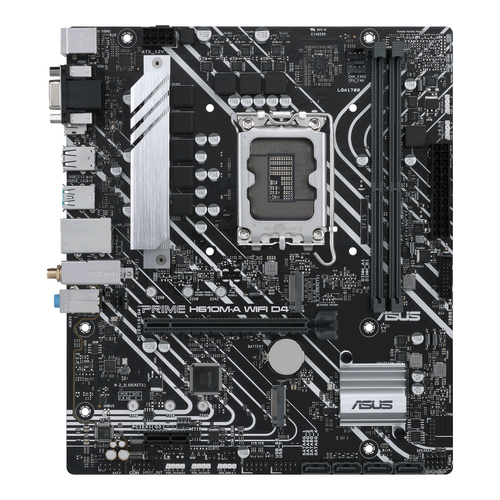
ASUS PRIME H610M-A WIFI D4
Intel H610 LGA 1700 micro ATX

ASUS PRIME H610M-A WIFI
Intel H610 LGA 1700 micro ATX

ASUS PRIME A620-PLUS WIFI motherboard
AMD A620 Socket AM5 ATX

ASUS PRO A620M-DASH-CSM
AMD A620 Socket AM5 micro ATX
