
ASUS MAXIMUS VI GENE Intel Z87 LGA 1150 (Socket H3) mini ATX
- Socket: LGA 1150 (Socket H3)
- Chipset: Intel Z87
- Form factor: mini ATX
- Memory: 4 × DDR3-SDRAM
All 45 specificationsProduct page at asus.com ↗
Versions
 micro ATX
 mini ATX
Where to buy
We're not tracking prices for this product yet. Check current prices directly at:
We may earn a commission when you buy through links on this page — at no extra cost to you. Learn more
About this product
Best Z87 gaming mATX loaded with 115dB SNR audio and overclocking features
- LGA1150 socket for 4th Generation IntelCore i7/ i5/ i3/ Pentium / Celeron Processors
- Intel Z87 Express Chipset
- SupremeFX - Supremacy through discrete-caliber audio
- Sonic Radar - Scan and detect to dominate
- mPCIe Combo II - Extra connections with new gen support
- Extreme Engine Digi+ III - Hardcore power delivery with premium components
- GameFirst II + Intel LAN - Put Your Frags First
- RAMDisk - Double up on speed with RAM
Maximus VI GENE: best mATX Z87 gaming and overclocking motherboard
The ROG GENE Series has long been the favorite choice of micro ATX power seekers. GENE boards have been the official BlizzCon motherboards for three consecutive years, forming the foundation for all official PCs used at the 2012 Battle.net World Championship.
Staying true to tradition, Maximus VI GENE arrives fully loaded for action. Extreme Engine Digi+ III precision power delivery, exclusive tuning utilities, and advanced gaming features. These include SupremeFX 115dB SNR crystal-clear audio, the Sonic Radar visualized in-game overlay, Intel Ethernet, and GameFirst II network optimization. Eager for mATX domination? Look no further.
SupremeFX
Differential signal design achieves 115dB SNR discrete-caliber audio
ROG has upped the game audio ante with an advanced differential circuit design. It includes an Op-Amp that combines two opposite-phased signals while filtering out noise interference during transmission, providing clear audio stream output with double the intensity. Moreover, SupremeFX on Maximus VI GENE also implements multi-approach shielding, with ELNA audio capacitors helping offer 8-channel HD sound that's equal in power, clarity, and range to dedicated sound cards. This is the first-ever onboard sound capable of true audiophile-grade performance, set to revolutionize the way you hear games, movies, music, and even other people via chat. Discover a whole new dimension of superior audio and get ready to rule. Click the button to learn more about SupremeFX!
mPCIe Combo II
The next evolution of the mPCIe Combo card gives you even better expandability with the latest standards in connectivity. It’s easy to install, and adds mini PCI Express 2.0 plus USB 2.0, which is perfect for connecting Wi-Fi and Bluetooth modules to give your desktop instant wireless. It also keeps a precious PCI Express slot free.
The compact but versatile card further future-proofs your build with M.2 (NGFF, Next Generation Form Factor) connectivity for SSDs. M.2 is a fast and power-efficient standard that aims to replace mPCIe and mSATA, designed to optimize SSD performance. mPCIe Combo II works with your high speed M.2 SSDs and makes the most of their potential, helping you reduce load times to make your OS and games even faster.
Extreme Engine Digi+ III
Hardcore power delivery with premium components
Completely digital architecture attains total control over the Fully Integrated Voltage Regulators (FIVR) of Intel processors to supply the highest stability and precision for the CPU and memory. The design features dynamic speed adjustments alongside intricate manual controls that allow you to push processors and RAM beyond their limits.
Power components are also upgraded. NexFET MOSFETs handle up to 90% efficiency under normal operation and better durability in half the size of standard MOSFETs. Exclusive BlackWing chokes remain cool even when sizzling with as much as 60 amps of power with 3-5°C lower temps and minimal-loss power delivery. Japan-made 10K Black Metallic capacitors last five times longer and deliver 20% greater extreme temperature endurance than generic solid state capacitors, easily standing up to hardcore demands.
Upgraded UEFI BIOS
Most award-winning in segment
The new ROG UEFI BIOS includes a Last Modified feature that records recent changes. And to make sure you never forget a tuning idea, the in-BIOS Quick Note is perfect for jotting down memos and system details. It sure beats easily-misplaced paper notes! There’s also F4 My Favorites and Shortcuts for easy access to the BIOS features you need most, and you can even adjust boot logo size. The new BIOS also lets you name individual SATA ports so you can easily identify them to save time when defining boot sequences and other drive-related settings.
With ROG Pulse, a cool flashing ROG logo indicates system activity, and very importantly, the helpful SSD Secure Erase has been added, restoring SSD speed from inside the BIOS and with no need for less compatible third party utilities. Click the upper right tab to learn more.
SLI/CrossFire On-Demand
Why choose when you can have both?
SLI or CrossFireX? Fret no longer because with the ROG Maximus VI GENE, you’ll be able to run both multi-GPU setups. The board features SLI/CrossFire on Demand technology, supporting up to Quad-GPU SLI or Quad-GPU CrossFireX configuration. Whichever path you take, you can be assured of jaw-dropping graphics at a level previously unseen.
SSD Secure Erase
Recover lost performance. Back to high speed
SSD performance degrades with time due to overwrite action. ROG is the world’s first motherboard brand to integrate SSD Secure Erase into UEFI BIOS for better compatibility and easier use, offering the best removal method to completely delete all data on an SSD to recover lost performance and restore factory speeds.
2nd generation T-Topology
5%+ full load OC margin and 10%+ with one DIMM
For extreme memory overclocking under full load, ASUS developed the world’s first 2nd generation T-Topology. It further optimizes layout to minimize coupling noise and signal reflection, increasing DRAM overclocking. Testing shows around 5% more OC margin under full load, and 10% OC margin growth for one-DIMM configurations.
Specifications
Key specifications
- Processor socketMechanical component(s) that provides mechanical and electrical connections between a microprocessor and a printed circuit board (PCB). This allows the processor to be replaced without soldering.
- LGA 1150 (Socket H3)
- Motherboard chipsetThe chipset connects the microprocessor to the rest of the motherboard.
- Intel Z87
- Motherboard chipset familyThe category of motherboard chipset e.g. Intel, AMD.
- Intel
- Motherboard form factorDesign of the motherboard (ATX, BTX etc).
- mini ATX
- Number of memory slotsThe total number of available sockets for installing memory modules.
- 4
- Supported memory typesTypes of memory which can be used with the product.
- DDR3-SDRAM
Show all 45 specificationsShow key specifications only
Features
- Component forWhat this product is used as a part of (component for).
- PC
- Motherboard form factorDesign of the motherboard (ATX, BTX etc).
- mini ATX
- Motherboard chipset familyThe category of motherboard chipset e.g. Intel, AMD.
- Intel
- Windows operating systems supportedWindows vesions wich can be used with the device.
- Windows 7 Home Basic, Windows 7 Home Basic x64, Windows 7 Home Premium, Windows 7 Home Premium x64, Windows 7 Professional, Windows 7 Professional x64, Windows 7 Starter, Windows 7 Starter x64, Windows 7 Ultimate, Windows 7 Ultimate x64, Windows 8, Windows 8 Enterprise, Windows 8 Enterprise x64, Windows 8 Pro, Windows 8 Pro x64, Windows 8 x64
Memory
- Supported memory typesTypes of memory which can be used with the product.
- DDR3-SDRAM
- Number of memory slotsThe total number of available sockets for installing memory modules.
- 4
- Memory slots typeA memory slot, also known as a memory socket or RAM slot, is what allows computer memory (RAM) to be inserted into the computer. Depending on the motherboard, there will usually be 2 to 4 memory slots (sometimes more on high-end motherboards). The most common types of RAM are SDRAM and DDR for desktop computers and SODIMM for laptop computers, each having various types and speeds.
- DIMM
- Memory channelsThe number of communication paths between the memory controller and the RAM, which affects data transfer bandwidth (e.g., Dual-channel).
- Dual-channel
- ECC сompatibilitySpecifies whether the product supports Error Correction Code (ECC) memory, which detects and fixes data corruption (e.g., ECC, non-ECC).
- Non-ECC
- Supported memory clock speedsMemory clock speed is the time it takes for a computer to complete basic operations. It refers to the computer's processing speed and is measured in hertz. It is however not such a reliable measure of a computer's speed as it doesn't take into account other factors like RAM and cache size.
- 1333,1600,1800,1866,2000,2133,2200,2400,2600,2666,2800,3000 MHz
- Unbuffered memoryIndicates whether the device supports the use of unbuffered memory modules.
- Yes
Processor
- Processor manufacturerThe manufacturer that produced the processor.
- Intel
- Processor socketMechanical component(s) that provides mechanical and electrical connections between a microprocessor and a printed circuit board (PCB). This allows the processor to be replaced without soldering.
- LGA 1150 (Socket H3)
- Compatible processor seriesA processor which is compatible with this device, belongs to a 'series' which is part of 'family' e.g Celeron D, Celeron G, Celeron M, or, in some cases, is the same as 'family'.
- Intel Celeron, Intel Pentium
Weight & dimensions
- WidthThe measurement or extent of something from side to side.
- 244 mm
- DepthThe distance from the front to the back of something.
- 244 mm
BIOS
- BIOS typeThe BIOS (Basic Input/Output System) initializes and tests system hardware components, and loads a bootloader or an operating system from a mass memory device. The BIOS additionally provides abstraction layer for the hardware, i.e. a consistent way for application programs and operating systems to interact with the keyboard, display, and other input/output devices. There are several types of BIOS…
- UEFI AMI
- BIOS memory sizeThe total storage capacity of the basic input/output system chip, measured in Mbit.
- 64 Mbit
- ACPI versionThe version of the Advanced Configuration and Power Interface standard supported by the device to manage power consumption and hardware configuration (e.g., 2.0).
- 5.0a
- Clear CMOS buttonIndicates whether the device features a dedicated external button to reset the CMOS settings to their factory defaults.
- Yes
Expansion slots
- PCI Express x4 (Gen 2.x) slotsThe number of available PCI Express x4 slots supporting generation 2.x specifications.
- 1
- PCI Express x16 (Gen 3.x) slotsPlaces where PCI Express x16 (Gen 3.x) are placed inside and connected to the computer motherboard.
- 2
- Mini PCI Express slotsThe number of internal expansion slots available for installing Mini PCI Express modules.
- 1
Performance
- Motherboard chipsetThe chipset connects the microprocessor to the rest of the motherboard.
- Intel Z87
Power
- Power source typeWhat the power source is.
- ATX
Ports & interfaces
- USB 2.0 ports quantityNumber of USB 2.0 ports (connecting interfaces) in the device. USB 2.0 was released in April 2000 (now called "Hi-Speed"), adding higher maximum signaling rate of 480 Mbit/s (effective throughput up to 35 MB/s or 280 Mbit/s), USB 2.0 ports are usually black.
- 4
- USB 3.2 Gen 1 (3.1 Gen 1) Type-A ports quantityThe total number of available USB 3.2 Gen 1 (formerly 3.1 Gen 1) Type-A connection ports on the device.
- 6
- Ethernet LAN (RJ-45) portsNumber of Ethernet LAN (RJ-45) ports (connecting interfaces) in the device. Ethernet LAN (RJ-45) ports allow a computer to connect to the ethernet.
- 1
- HDMI ports quantityThe number of sockets (ports) for HDMI connections. HDMI (High-Definition Multimedia Interface) is a compact audio/video interface for transferring uncompressed video data and compressed/uncompressed digital audio data from a HDMI-compliant device ("the source device") to a compatible computer monitor, video projector, digital television, or digital audio device. HDMI is a digital replacement for…
- 1
- Headphone outputsNumber of sockets /ports where headphones are connected.
- 1
- Microphone inThe socket where a microphone is connected to the device.
- Yes
- S/PDIF out portS/PDIF (Sony/Philips Digital Interconnect Format) is a digital audio interconnect used in consumer audio equipment over relatively short distances. The signal is transmitted over either a coaxial cable with RCA connectors or a fibre optic cable with TOSLINK connectors.
- Yes
Internal I/O
- USB 2.0 connectorsThe end of a cable with a USB 2.0 connector. USB 2.0 was released in April 2000 (now called "Hi-Speed"), adding higher maximum signaling rate of 480 Mbit/s (effective throughput up to 35 MB/s or 280 Mbit/s), in addition to the "USB 1.x Full Speed" signaling rate of 12 Mbit/s. USB 2.0 connectors are usually colored black.
- 2
- USB 3.2 Gen 1 (3.1 Gen 1) connectorsThis is a connector (normally attached to a cable) for USB 3.0. USB 3.0 is the second major revision of the Universal Serial Bus (USB) standard for computer connectivity. First introduced in 2008, USB 3.0 adds a new transfer mode called "SuperSpeed," (distinguishable from USB 2.0 by either the blue colour of the port or the initials SS) capable of transferring data at up to 5Gbit/s—more than ten…
- 1
- Number of SATA connectorsThe total number of Serial ATA (SATA) ports available on the unit for connecting storage devices.
- 8
- S/PDIF out connectorIndicates whether the product features a Sony/Philips Digital Interface (S/PDIF) port for transmitting digital audio signals.
- Yes
- Front panel audio connectorIndicates whether the product has a dedicated header to connect audio jacks located on the front panel of a chassis.
- Yes
- ATX Power connector (24-pin)Indicates whether the product features a 24-pin ATX power connector for main power supply connectivity.
- Yes
- Number of EATX power connectorsThe total number of extended ATX (EATX) power sockets available on the product for additional power delivery.
- 1
- CPU fan connectorIndicates whether the product has a dedicated header for connecting a CPU cooling fan.
- Yes
- Number of chassis fan connectorsThe total number of internal headers available to connect case cooling fans (e.g. 3 or 4).
- 3
- Chassis intrusion connectorIndicates whether the product has a dedicated header to connect a switch that detects when the case has been opened.
- Yes
- TPM connectorIndicates whether the product features a dedicated header for connecting a Trusted Platform Module (TPM) security chip.
- Yes
Storage
- Supported storage drive interfacesThe physical and logical connection standards supported for connecting storage drives to the system (e.g., M.2 or SATA).
- SATA
- RAID levelsRAID is a storage technology that combines multiple disk drive components into a logical unit for the purposes of data redundancy and performance improvement. Data is distributed across the drives in one of several ways, referred to as RAID levels, depending on the specific level of redundancy and performance required.
- 0, 1, 5, 10
Database Right data-sheet 2026 Icecat. All rights reserved. Provided “as is”, without warranty — check details with the store before buying.
Expert reviews
- 100
expertreviews.co.uk2013
A great, compact board for gaming enthusiasts who want to push their systems to the extreme...
Read the review at expertreviews.co.uk ↗
Price history (90 days, best daily price)
Price history is still being collected for this product — check back soon.
Alternative models

ASUS Z87-WS motherboard
Intel Z87 LGA 1150 (Socket H3) ATX
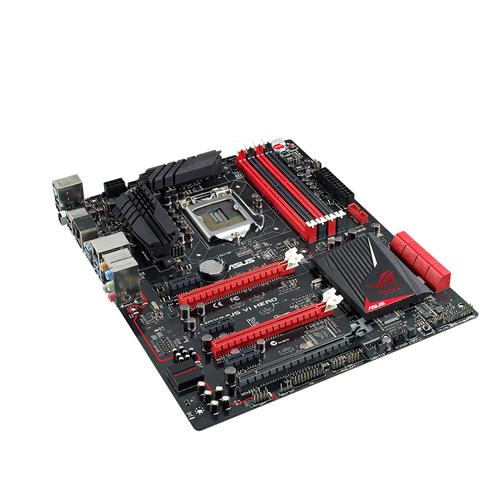
ASUS MAXIMUS VI HERO
Intel Z87 LGA 1150 (Socket H3) ATX

ASUS H87I-PLUS
Intel H87 LGA 1150 (Socket H3) mini ITX

ASUS H87M-PLUS
Intel H87 LGA 1150 (Socket H3) micro ATX

ASUS Q87M-E LGA 1150 (Socket H3) micro ATX

ASUS B85M-G
Intel B85 LGA 1150 (Socket H3) micro ATX